 Book Consultation
Modern pooja room design: blue, gold and quiet devotion
A contemporary prayer space works when it is planned with the home rather than added to it. Where it belongs, why blue and gold holds, and what survives a daily lamp.

In most Bangalore and Hyderabad flats, the prayer space is the last thing planned and the first thing that goes wrong. A modern pooja room design gets decided in the final week, after the wardrobes and the kitchen are locked, and it lands wherever a leftover metre of wall survives. Then the lamp blackens the soffit and ash settles into a shelf nobody can reach. A prayer space holds up when it is drawn at the same time as the rest of the floor plan, not after it.
What follows is not a gallery of mandirs. It is the set of decisions that make a prayer space feel deliberate, survive a daily oil lamp, and still belong to the same home as the living room.
01 Where the prayer space belongs when a dedicated room is rare
A separate pooja room is a luxury of plan area. In a 1,600 to 2,000 square foot apartment you are carving the space out of something else: the end of a passage, a niche beside the dining, a bay off the foyer, a unit built into a living room wall. That choice is about circulation before it is about looks. Ask where people stand during an aarti, and whether the person lighting the lamp has their back to a walkway.
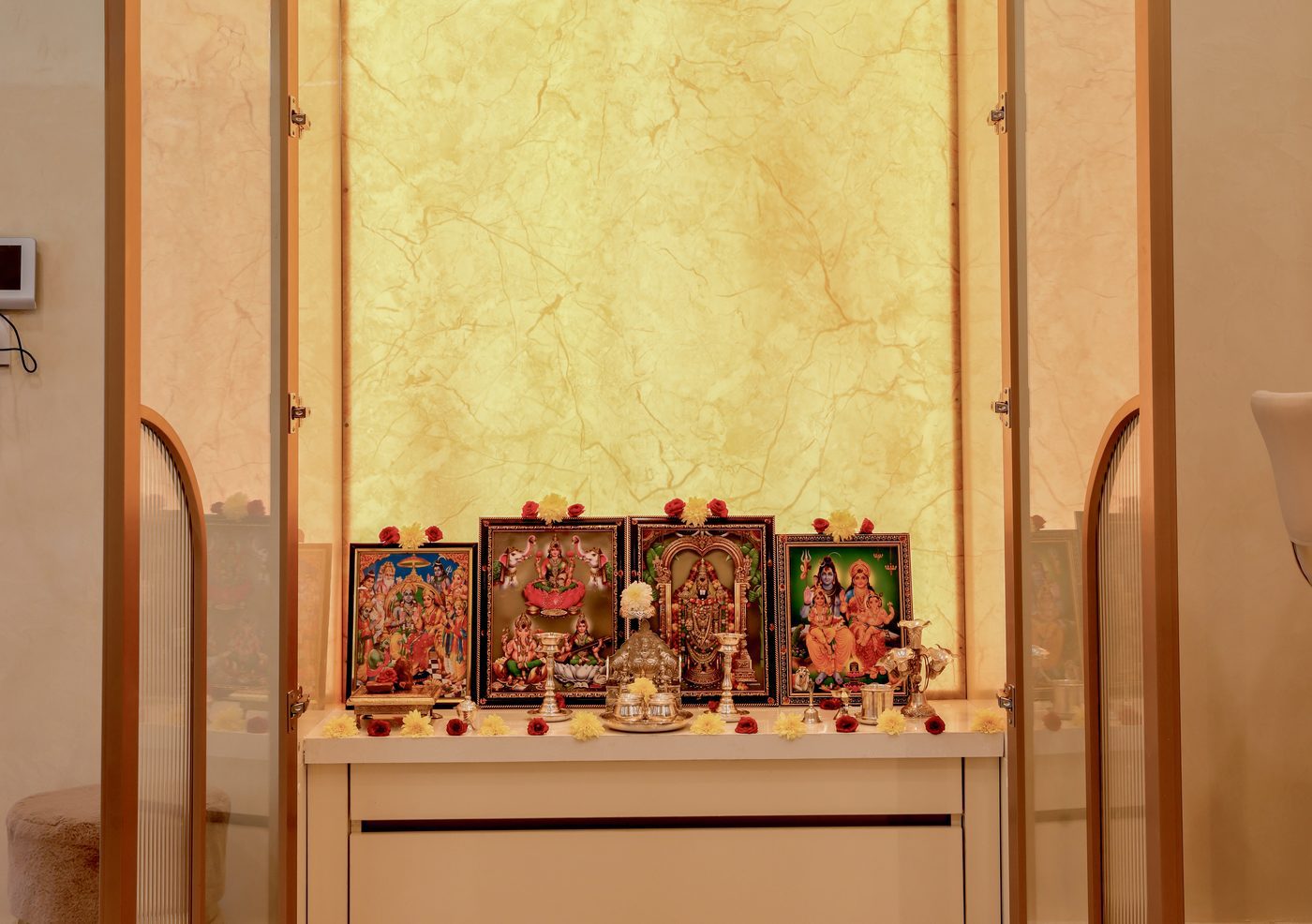
Two rules do most of the work. Keep roughly 900mm of clear floor in front of the counter, so standing there blocks no route. And give the space a threshold: a change in floor material, a dropped soffit, a step, a pair of doors. The unit at Auro Kohinoor, Hyderabad uses slim brass framed glass doors. Open, the space is part of the room. Closed, it reads as a quiet panel of stone.
02 Blue, gold, and light that reads as devotion
Gold on its own goes flat. It needs a dark field, and blue carries meaning here rather than just contrast. A deep indigo behind a gold Om or a fine line drawing gives you the depth of a night sky, and the gold stops looking like trim and starts looking like light.
What separates a prayer space from a display cabinet is where the light comes from. Downlights on a shelf make a vitrine. Light from behind or inside the surface makes a shrine. A backlit onyx look marble panel, a translucent sheet behind a gold roundel, an LED strip washing the back wall: the surface itself glows and the idols sit in front of a source rather than under one. Keep it warm, 2700K to 3000K. Cooler than that and brass goes grey.
A backlit panel is only as honest as the joinery behind it
Backlighting is unforgiving. If the substrate flexes, an LED strip shows as scallops instead of an even wash, and the joints around a translucent panel open within a season. That is a carcass and hardware problem before it is a lighting problem, which is why the unit is built in our own facility.
- 4,500+ homes delivered
- 10-year warranty on woodwork
- Branded certified plywood
- Hettich hardware
- 3D renders for two rooms before you commit
- 4+ star rated
03 Materials that live with a flame
This is where prayer spaces fail, and it is worth being precise.
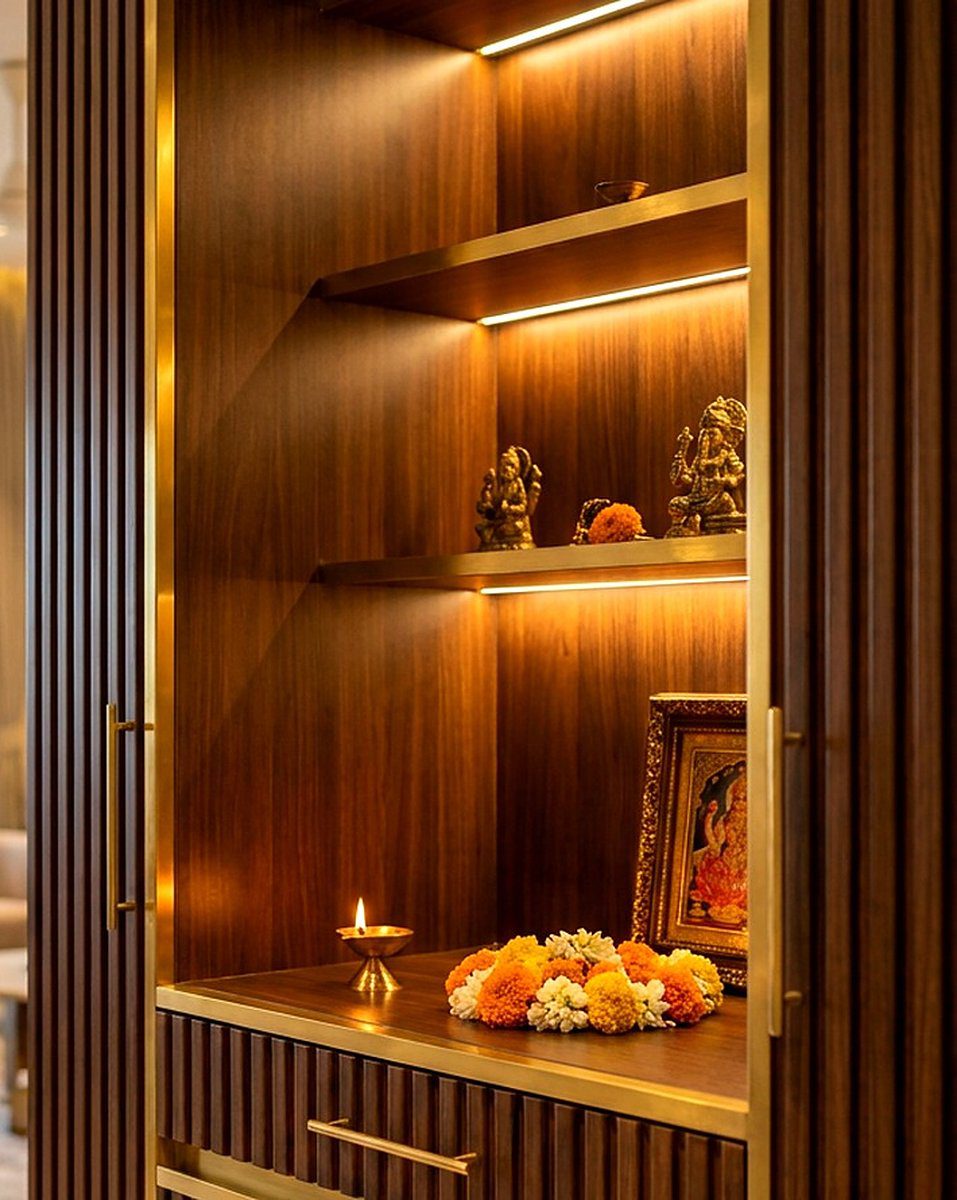
Brass, copper and natural stone cope. Brass darkens, cleans back with a mild polish, and heat does not trouble it. Granite and marble take direct contact from a diya, though marble is porous and will hold a ghee or turmeric stain if it is not sealed and wiped the same day. Engineered quartz is the one to watch: it looks like stone until heat reaches it, because the resin binder begins to fail around 150C, and a hot lamp base leaves a permanent mark. The genuinely heat-proof surfaces are sintered stone and porcelain.
Laminate and veneer are fine for the body of the unit and not fine at the flame. Wherever a lamp, a camphor holder or an incense stand actually sits, put a stone or metal sill under it, ideally a removable brass tray, so the surface that gets scorched is one you can lift out and clean.
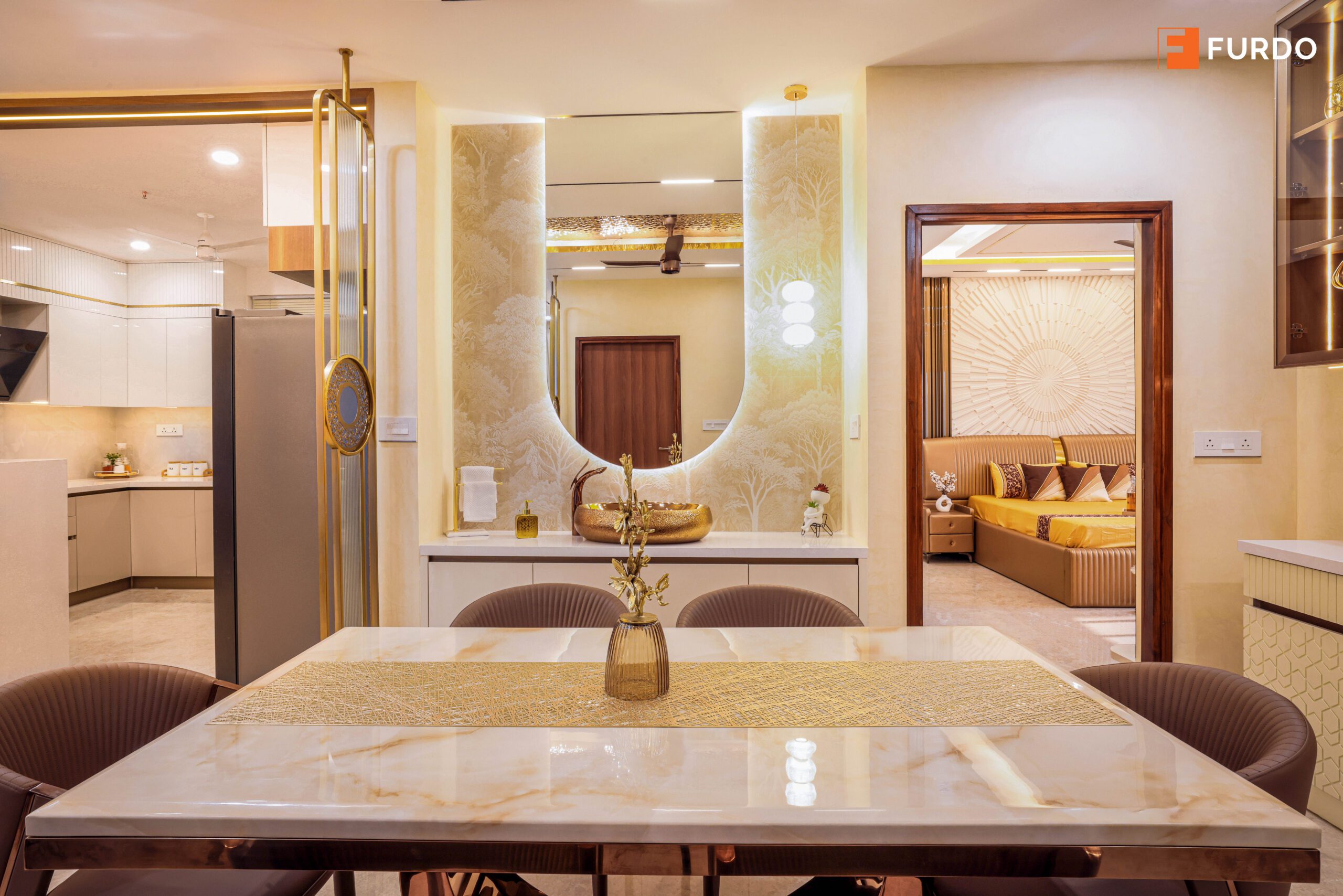
Ventilation matters as much as the surface. Camphor and ghee smoke find the nearest ceiling and stain it, so either give the space an exhaust path or accept a wipeable soffit and a repaint cycle. Keep fabric out of the smoke line. If the prayer space sits near the dining or the kitchen, plan it alongside those zones the way a proper room by room plan would.
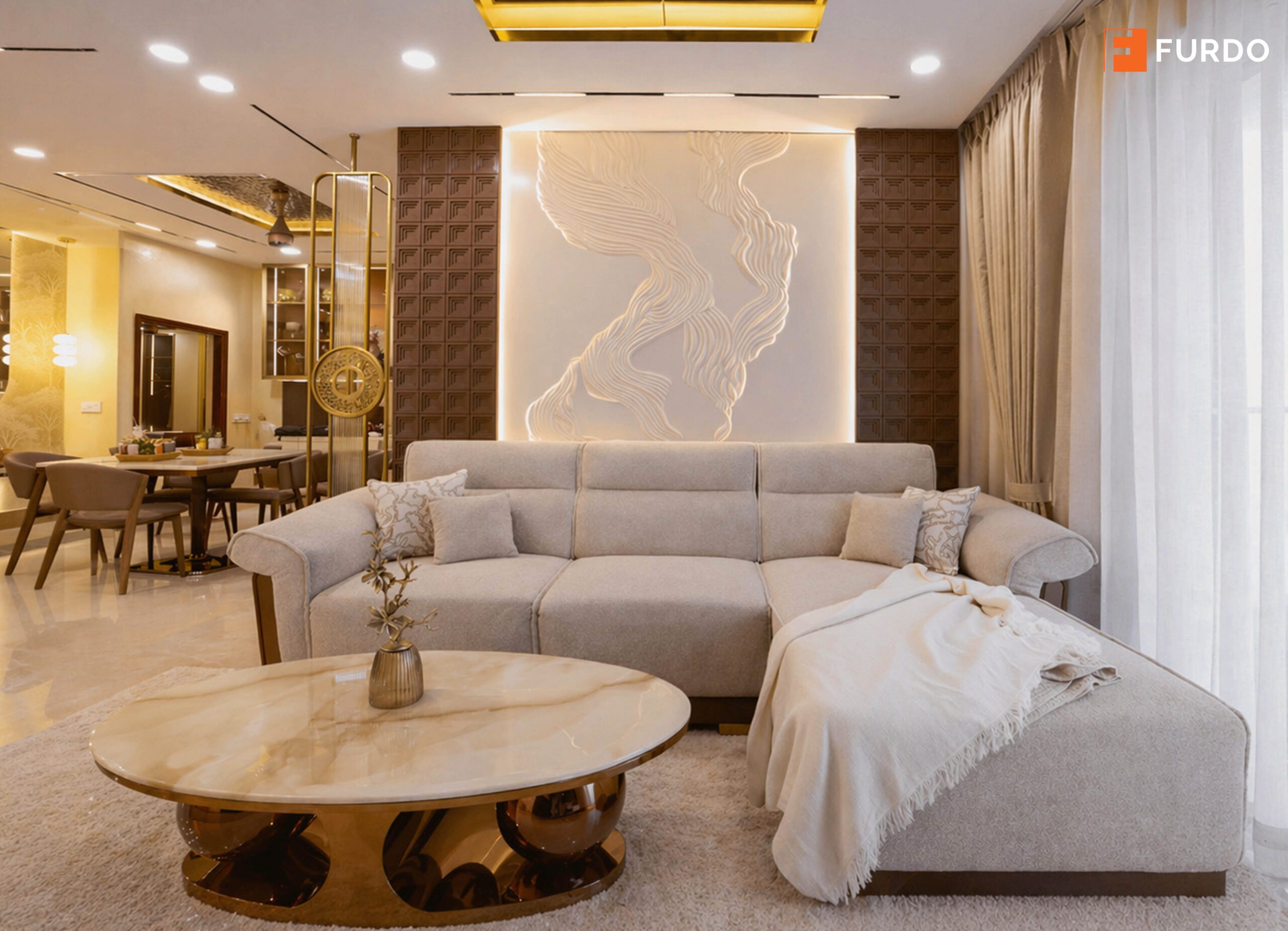
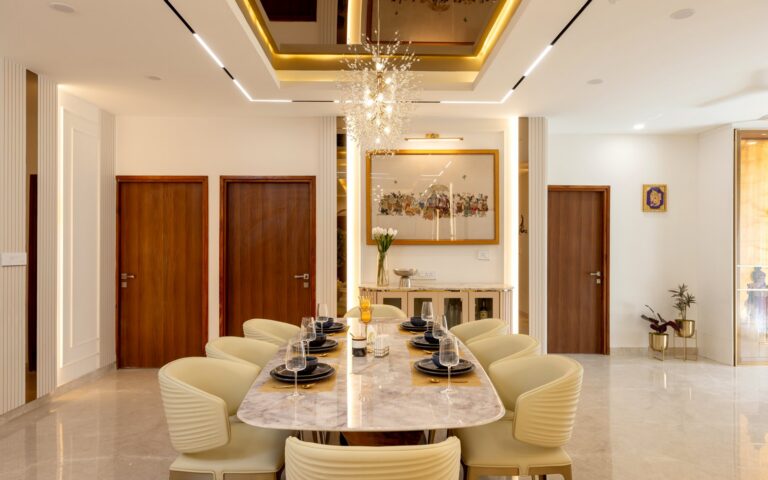
The last decision is the one people skip. Continuity. If the living room runs marble and gold fluting, the prayer space should speak that language softly. When the palette carries through, the space belongs to the home. When it does not, a built-in reads like furniture that arrived separately.
Planning a prayer space in a Bangalore or Hyderabad apartment? Bring us the floor plan before the joinery is frozen.
Book Consultation04 What to check in your own home
- Clear floor, not just clear wall. Stand where you would stand and measure. About 900mm in front of the counter, and nothing that swings into it. A prayer space that blocks a passage gets used less each year.
- A sill you can replace. Under the lamp, stone or brass, ideally a loose tray. Assume it will be scorched and stained. The question is whether that is a swap or a rebuild.
- Storage sized to what you actually use. Count what you handle weekly, then what you handle at festivals. Drawers for the first, closed shelving for the second, and nothing open that collects ash.
- Hidden warm sources. No visible LED dots, no cool white. Backlight or graze the surface at 2700K to 3000K, and put the switch where you reach at dawn.
- A wipeable surface overhead. Whatever sits above the flame will darken. Choose a finish that takes a cloth, and keep fabric, wallpaper and raw wood clear of it.
An honest note on Vastu
Most homeowners raise this first, so it is worth stating plainly. The convention is a north-east placement, the person praying facing north or east, idols not set facing south, no shared wall with a bathroom, nothing under a staircase, and a threshold kept clear. In an apartment the orientation is already fixed, and the north-east corner is often a bedroom or a balcony. What design still controls is the direction you face, which wall the unit backs onto, and the clean approach in front of it. Where the plan allows the preference, we follow it. Where it does not, we say so. Our Vastu guide covers the rest of the home.
05 How Furdo plans this
Design begins with the plan rather than the elevation, fixing where you stand, what you face, and which zone the prayer space borrows from. Visualize puts it in front of you as high-definition, photoreal 3D renders of two rooms before you commit, which is when a backlit panel either reads as devotional or does not. Build happens in our in-house manufacturing facility on branded certified plywood with Hettich hardware, carried by a 10-year warranty on the woodwork. See it across a whole home in our Auro Kohinoor project notes.
06 Frequently asked questions
Where should a pooja space go in a flat with no spare room?
Wherever it gets a threshold and clear standing room. A passage end, a dining niche or a foyer bay all work. Prioritise 900mm of unobstructed floor and a wall not shared with a bathroom.
Is engineered quartz safe under an oil lamp?
No. Its resin binder starts failing near 150C, so a hot lamp base can scorch it permanently. Use granite, marble, brass, sintered stone or porcelain at the flame.
Can a backlit marble panel take the heat from a diya?
The stone can, provided the lamp is not standing on the panel itself. Keep the flame on a counter sill of stone or brass, and hold 150mm of clearance from any acrylic or LED housing.
Does blue actually work in a prayer space?
It works better than most alternatives. Blue gives gold the dark field it needs to read as light rather than trim, and it sits comfortably beside marble, brass and pale wood.
How much space does a compact prayer unit need?
A usable built-in fits in about 900mm of width and 400mm of depth, plus standing room in front. Below that a wall-hung unit still works, but plan the storage and the sill carefully.