 Book Consultation
From Factory to Home: What In-House Manufacturing Actually Changes
Most interior design firms design your home, then hand the actual manufacturing of your furniture to someone else. Furdo doesn’t. Here’s what owning that manufacturing changes for the piece sitting in your bedroom right now.

Most interior design firms design your home, then hand the actual manufacturing of your furniture to someone else — a local carpenter, a job-work unit, a workshop three cities away. Furdo keeps manufacturing in-house. Here is what that actually changes for the piece that ends up in your bedroom.
01 What “in-house” actually means, and what it doesn’t
In-house manufacturing means the same company that designs your home also builds it: the wardrobes, the kitchen carcasses, the TV units, the wall panelling. One organisation, one accountable chain from render to handover, rather than a design team handing the work to a separate workshop.
It doesn’t mean everything in your home is made from scratch on a factory floor. Loose furniture — sofas, dining chairs, soft furnishings — is still sourced, the way it is by most design firms. What Furdo manufactures in-house is the fixed furniture: the built-in, made-to-measure pieces that have to fit your exact home and are meant to outlast a decade of daily use.
02 The hidden hop most interior firms don’t mention
Across the industry, it’s common for an interior design firm to run as a design-and-project-management business, with the actual manufacturing handled by a separate contractor it doesn’t own. That’s simply how the category is usually structured, and it’s worth asking about before you sign anything — see how a quotation is actually built for where this hop tends to hide inside a cost breakdown.
Every hop between designer and maker is a place where the drawing can drift from the finished piece: a shutter thickness quietly downgraded, an edge-band swapped for a cheaper batch, a hinge substituted because the specified one wasn’t in stock that week. The designer who signed off on the drawing usually isn’t the one standing at the workshop when any of that happens.
03 Why the same drawing can turn into two different wardrobes
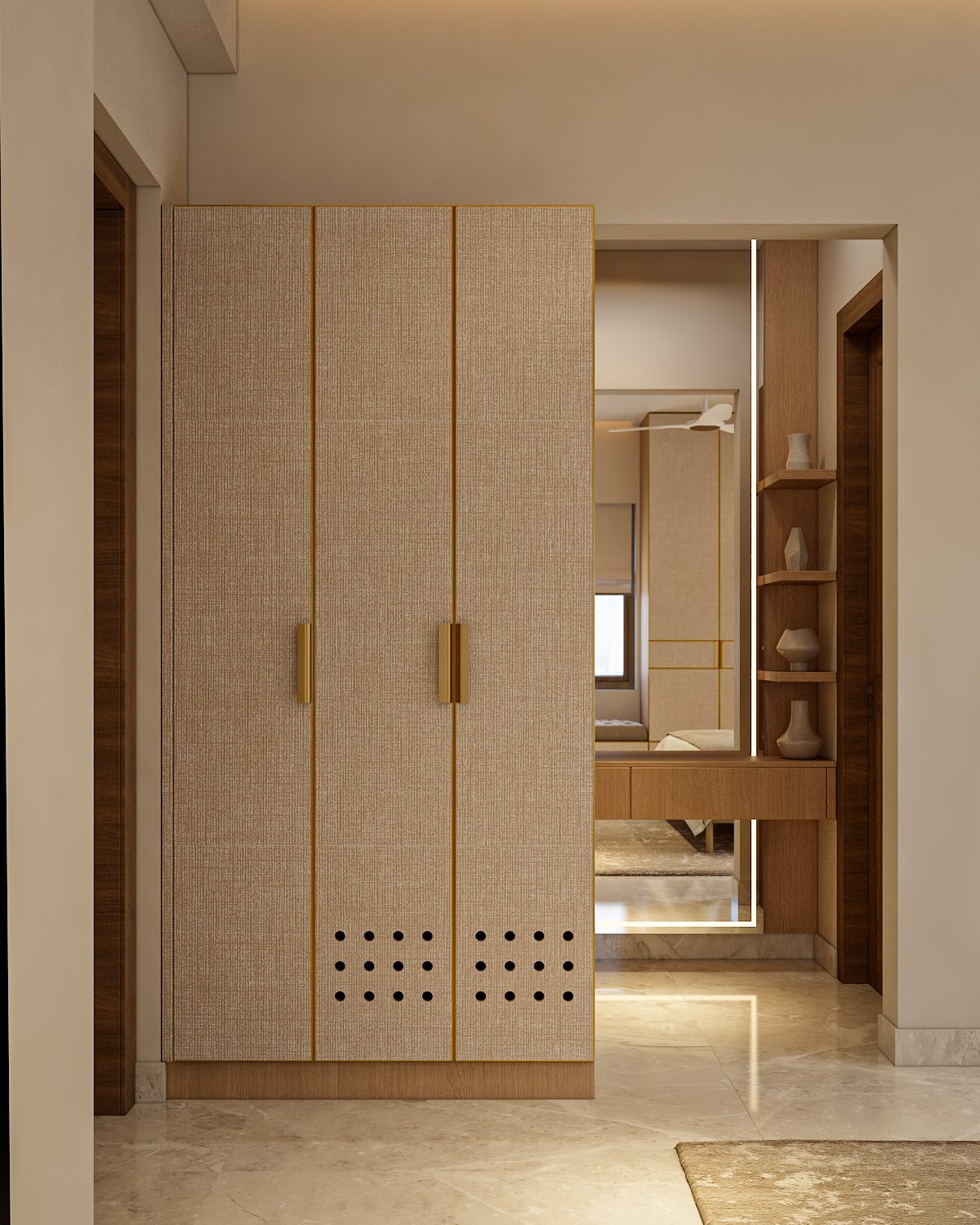
Send the identical CAD drawing to two different workshops and you will not get the identical wardrobe back. Board grade, edge-banding quality, hinge cycle-rating, and the tolerance a fitter works to are all decisions made on the shop floor, not on the drawing — and a firm that doesn’t own the floor has limited ability to enforce any of them consistently, project after project.
Owning manufacturing doesn’t make every decision perfect. It means the same standards apply whether your project is the first job of the month or the fortieth, because the same team and the same suppliers are running every one of them.
What in-house manufacturing lets us promise, and prove
Design is life engineering, not decoration — and a promise about how a home will hold up only means something if the company making that promise also controls how it’s built. In-house manufacturing is what makes the rest of what Furdo commits to enforceable:
- A dedicated designer from first sketch to handover
- High-definition, photoreal 3D renders of your own home before work begins
- Branded, certified plywood specified once, used every time
- One accountable team, not a chain of subcontractors
- 4,500+ homes delivered, 4+ star rated
- A 10-year warranty backed by the people who built it
04 What it changes about materials, not just furniture
The Material Manifesto that guides every Furdo project — natural wood veneers over excessive MDF, branded certified plywood over high-formaldehyde boards, water-based finishes over cheap laminates — is only as good as a team’s ability to actually enforce it, board by board, on every project. A firm that outsources manufacturing can write the same manifesto. Whether it survives contact with a job-work unit’s own supplier relationships is a separate question, and one a buyer usually can’t see from a sample chip.
05 The warranty math: why 10 years only works with control of the floor
A 10-year warranty is a commitment about hinges, carcass boards, edge-banding adhesion and hardware that hasn’t even been stressed by daily use yet. Making that commitment credible requires knowing, with certainty, what went into every piece: which supplier, which batch. That traceability is difficult to guarantee across a subcontracted supply chain, and considerably more straightforward when manufacturing sits inside the same company issuing the warranty.
This is also why execution speed doesn’t lead Furdo’s messaging the way it does for some firms. A promise measured in years, not weeks, is the whole point.
06 What to ask any firm before you sign
You don’t need to take a claim about “in-house manufacturing” at face value from anyone, including Furdo. A few direct questions usually settle it:
- Does the company that designed my home also own the factory that will build it, or is manufacturing subcontracted?
- Can I see the actual facility, or is “in-house” a description of a partner relationship?
- Who is accountable if a board grade or hardware spec is substituted after I’ve approved the drawing?
- What does the warranty actually cover, and who honours it if the manufacturing partner changes?
- How is quality checked between the workshop and my home, and by whom?
The answers tell you more about what you’re actually buying than any render can. If you’re comparing firms on this basis, our guide on choosing the right interior design partner walks through the rest of the checklist.
See what in-house manufacturing looks like for your own home.
Book a design consultation07 Frequently asked questions
Does “in-house manufacturing” mean Furdo makes every single item in my home?
No. Furdo manufactures the fixed, made-to-measure furniture in-house, including wardrobes, kitchen carcasses, TV and media units, wall panelling and similar built-in pieces. Loose furniture like sofas and dining chairs is still sourced, as it is by most design firms.
Is in-house manufacturing more expensive than outsourced manufacturing?
Not inherently. The cost difference between firms usually comes down to material grade, design complexity and project scope more than whether manufacturing is in-house. What in-house manufacturing changes is consistency and accountability, not necessarily the price on the quotation.
How does in-house manufacturing affect the 10-year warranty?
It makes the warranty enforceable. Because Furdo manufactures the furniture it warranties, there is a direct, traceable line from the materials and hardware used to the team backing the warranty, rather than a claim resting on a third-party workshop’s own commitments.
What should I ask about visiting a firm’s manufacturing facility?
Ask any firm you are evaluating whether their manufacturing facility can be visited, and ask to see it before signing. A firm that genuinely manufactures in-house should be able to show you where your furniture will actually be built.
Does in-house manufacturing mean faster delivery?
Not necessarily, and it should not be the reason to choose it. Furdo’s focus with in-house manufacturing is quality, material accuracy and warranty accountability, not compressed timelines. A home is worth building correctly rather than quickly.